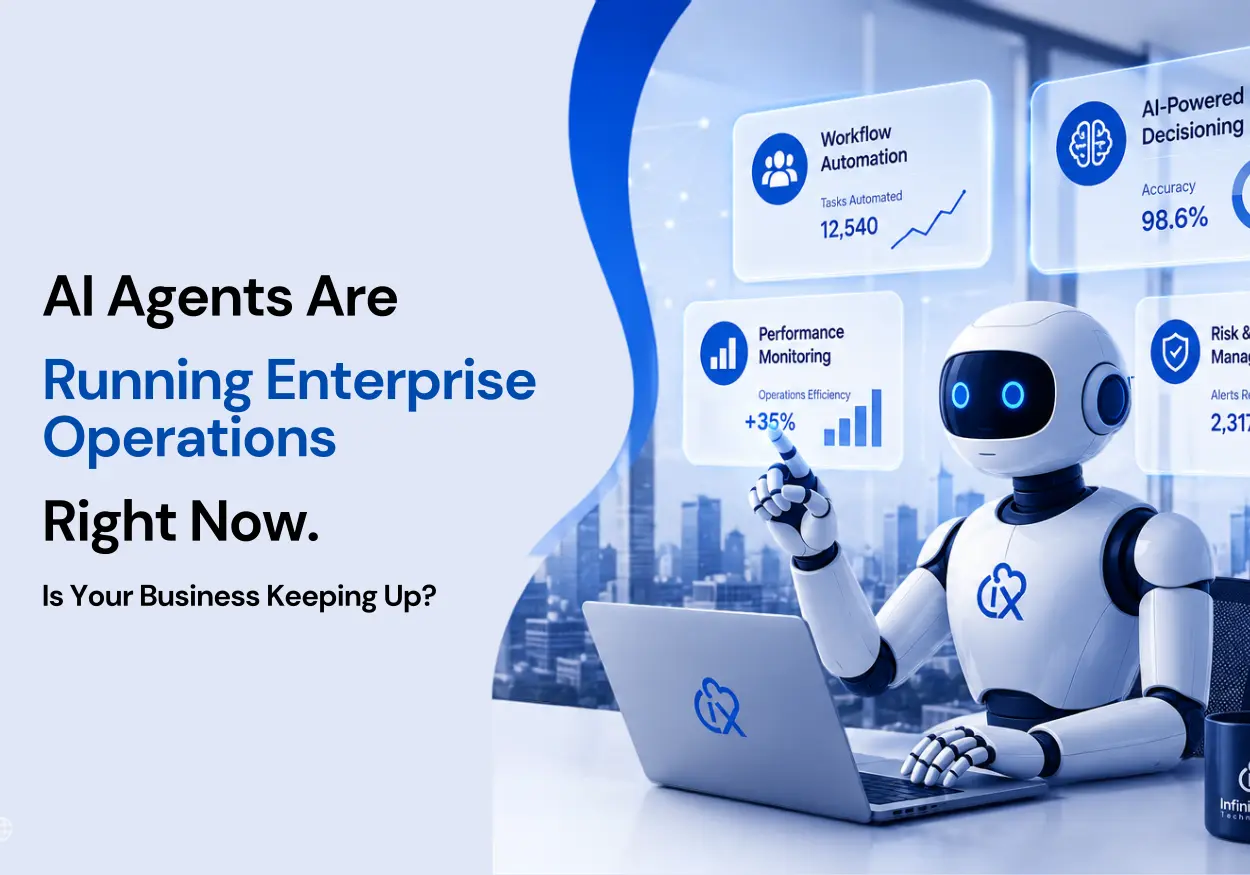
AI Agents Are Running Enterprise Operations Right Now. Is Your Business Keeping Up?
Somewhere right now, an AI agent is resolving a customer support ticket at 2 a.m. without a human touching it. Another is pulling data from three enterprise systems, generating a compliance report, and flagging an anomaly for review - before the analyst arrives at their desk. A third is qualifying inbound sales leads, routing the high-priority ones to your team, and scheduling discovery calls automatically.
None of this is science fiction. It is the operational reality for businesses that have deployed enterprise AI automation in the past 18 months.
The gap between companies that have integrated AI agents into their workflows and those still evaluating the concept is widening - faster than most leadership teams realize. This guide is for the decision-makers on the evaluating side who want a clear, honest picture of what AI agents do, what they cost, what they return, and how to get started without expensive missteps.
What Is an AI Agent - and Why Does the Definition Matter for Your Business?
An AI agent is a software system that uses artificial intelligence to perceive its environment, make decisions, execute tasks, and adapt its behavior based on feedback - all with minimal human intervention once deployed.
Unlike traditional automation tools (which follow rigid, pre-programmed rules), AI agents powered by machine learning and natural language processing can handle ambiguous inputs, learn from new data, and improve performance over time. The practical difference is significant: a rule-based chatbot fails the moment a customer asks something outside its decision tree. An NLP-based AI agent understands intent, asks clarifying questions, and resolves the issue or escalates intelligently.
The three types InfiniTechX builds:
Rule-based agents - Deterministic logic for high-volume, well-defined tasks (data entry validation, form routing, basic workflow triggers). Fast to deploy, predictable, and cost-effective for structured processes.
Machine learning agents - Agents that improve performance over time by learning from historical data and outcomes. Best for tasks where patterns exist but rules can't fully capture them - fraud detection, demand forecasting, personalization engines.
NLP-based agents - Conversational AI systems that understand and respond to natural language. Deployed in customer service, internal helpdesks, sales qualification, and document processing.
Most enterprise deployments combine all three, with InfiniTechX's team determining the right architecture for each workflow being automated.
Where AI Agents Are Delivering Real Business Results
AI agents are not general-purpose tools. Their value is highly specific to the workflows they're embedded in. Here is where enterprises are seeing the clearest returns:
Customer Service and Support
AI agents handle tier-1 and tier-2 support queries across chat, email, and voice - 24 hours a day, seven days a week. They resolve common issues instantly, gather context before escalating complex cases, and maintain consistent tone and accuracy across every interaction. Businesses typically see first-response times drop from hours to seconds and deflection rates (queries resolved without a human agent) reach 40–70% within the first quarter of deployment.
Sales and Revenue Operations
In outbound and inbound sales, AI agents qualify leads against your ideal customer profile, personalize outreach at scale, and schedule meetings with qualified prospects directly into sales rep calendars. They also monitor CRM activity and surface deal risks before they become lost opportunities.
IT Operations and Internal Helpdesks
For internal teams, AI agents handle password resets, software provisioning requests, onboarding checklists, and routine troubleshooting - the low-complexity, high-volume tickets that consume disproportionate IT team bandwidth. This frees technical staff to focus on infrastructure, security, and strategic projects.
Finance, Compliance, and Reporting
AI agents pull data from ERP systems, generate routine financial reports, flag anomalies, and ensure data completeness before reports reach human reviewers. In regulated industries, they also assist with compliance documentation and audit trail maintenance - reducing both manual effort and the risk of human error in high-stakes processes.
The InfiniTechX AI Agent Practice: What We Build and How
InfiniTechX's AI agent services cover the full development and deployment lifecycle. Here is what that means in practice:
Custom AI Agent Development
For workflows where no off-the-shelf solution fits, we build AI agents from the ground up - designed around your specific data environment, user expectations, integration requirements, and performance KPIs. Custom development includes agent architecture design, training data curation, model selection, and iterative testing before any production deployment.
Third-Party AI Agent Integration
Many enterprises already have AI tools in their stack - Microsoft Copilot, Salesforce Einstein, ServiceNow, or others. InfiniTechX integrates these agents into your broader systems landscape, ensuring clean data exchange, consistent workflows, and no operational blind spots. Integration work connects agents to your CRM, ERP, cloud platforms, and internal databases so agents act on real, current information rather than isolated data snapshots.
AI Agent Monitoring, Analytics, and Optimization
Deploying an agent is not the end of the engagement - it is the beginning of the performance phase. InfiniTechX provides ongoing monitoring and analytics services that track resolution rates, accuracy, escalation patterns, and user satisfaction. We use this data to retrain models, adjust decision logic, and optimize agent behavior continuously. This is how agents get meaningfully better over months, not just marginally better.
AI Agent Security and Compliance
Enterprise AI deployments handle sensitive data. InfiniTechX builds security into agent architecture from the start: role-based access controls, data encryption in transit and at rest, audit logging, and compliance alignment with HIPAA, SOC 2, GDPR, and other relevant frameworks depending on your industry. For businesses in regulated sectors - fintech, healthtech, legal, insurance - compliance is not a feature; it is a prerequisite.
What ROI Should You Realistically Expect From an AI Agent?
What is the ROI of deploying an enterprise AI agent?
ROI from enterprise AI agent deployments typically comes from three sources: labor cost reduction (handling tasks previously requiring human time), error reduction (eliminating costly mistakes in repetitive processes), and speed improvement (reducing cycle times that affect customer experience or revenue recognition).
Well-scoped AI agent deployments commonly achieve payback periods of six to eighteen months, with long-term annual savings in the range of 20–40% of the labor cost for the automated workflows. The most reliable way to estimate your specific ROI is a workflow assessment - which InfiniTechX conducts as part of our AI Agent Strategy and Consulting engagement.
How InfiniTechX Approaches AI Agent Deployment
Every InfiniTechX AI agent engagement follows a structured process designed to minimize risk and maximize time-to-value:
1. Discovery and Workflow Assessment: We map your existing processes, identify automation candidates ranked by value and feasibility, and define success metrics before any technical work begins.
2. Agent Design and Architecture: We select the right agent type (rule-based, ML, NLP, or hybrid), define the data inputs and integration touchpoints, and design the decision logic that will govern agent behavior.
3. Development and Training: We build the agent, train or configure models using your data where applicable, and conduct rigorous testing - including edge case simulation and failure mode analysis.
4. Integration and Deployment: We connect the agent to your live systems - CRM, ERP, ticketing platforms, communication tools - and deploy in a monitored rollout to catch any production-environment issues early.
5. Ongoing Optimization: Post-launch, we monitor performance, analyze outcomes, and continuously improve agent accuracy and coverage through retraining and logic refinement.
For businesses at the earlier stages of AI adoption, our Technology Consulting team can help establish the data infrastructure and organizational readiness needed before agent deployment begins. For those ready to move quickly, our MVP Development practice enables rapid proof-of-concept builds that demonstrate agent value before full-scale investment.
Frequently Asked Questions About AI Agents
Q: What is the difference between an AI agent and a standard chatbot? A standard chatbot follows predefined scripts and fails when users deviate from expected paths. An AI agent uses machine learning and natural language processing to understand intent, handle variation, learn from interactions, and take actions across connected systems - not just respond with text.
Q: How long does it take to deploy an AI agent? The timeline depends on complexity. A well-scoped AI agent for a single use case (such as a customer support agent with defined escalation rules) can go from design to production in eight to twelve weeks. Enterprise-wide deployments with multiple agent types and deep system integrations typically take three to six months across phased rollout.
Q: Do AI agents require large amounts of proprietary data to work? Not always. Rule-based and many NLP agents can be deployed with limited training data by leveraging pre-trained language models and fine-tuning them for your domain. Machine learning agents that handle prediction or classification tasks do benefit from historical data volume. InfiniTechX's discovery phase includes a data readiness assessment to determine the right approach.
Q: Can AI agents integrate with the software we already use? Yes. InfiniTechX's integration practice connects AI agents to the most common enterprise platforms - Salesforce, HubSpot, SAP, Microsoft Dynamics, ServiceNow, Zendesk, and others - as well as custom internal systems via API or direct database connection.
Q: How do you ensure AI agent outputs are accurate and trustworthy? Accuracy is a function of training data quality, agent architecture, and ongoing monitoring. InfiniTechX builds human-in-the-loop checkpoints for high-stakes decisions, implements confidence thresholds that trigger escalation when the agent is uncertain, and tracks accuracy metrics continuously post-deployment. Agents are retrained when performance degrades or new data patterns emerge.
The Next Step Starts With a Conversation
AI agents are not a future investment - they are a present competitive advantage for businesses that move decisively. The enterprises winning with AI right now are not necessarily the largest or the most technically sophisticated. They are the ones that started with a clearly scoped problem, a pragmatic partner, and a commitment to measuring outcomes.
InfiniTechX works with businesses across the USA and India to design, build, and continuously improve AI agents that generate real, measurable business value - not proof-of-concept demos that never reach production.
Recent Post
Browse all post
From Copilots to Autonomous Co-Workers: How Agentic AI Is Redefining Enterprise Software in 2027
Top 20 Technology Trends in 2027 That Will Shape the Future of Business