Choosing the Right AI Agent Platform for Enterprise Workflows.
AI agents are becoming enterprise tools that can plan, execute and collaborate on business tasks, rather than just suggest responses. An AI agent platform is a tool that allows enterprises to build, deploy, run and oversee AI agent systems in a defined space.
A company selects an AI agent platform depending on the tasks it needs to complete, the applications it runs, its existing expertise, and its risk tolerance. A way to assess the options is to outline the skills and capabilities of the various agents and to rank the tools according to the criteria of the job. Organizations should also specify the conditions for deploying a tested AI agent platform.
What An AI Agent Platform Does And When You Need One
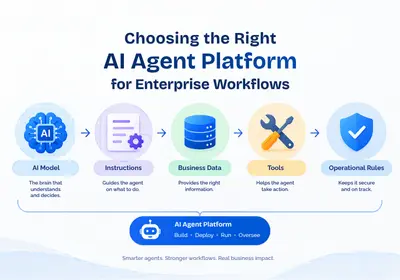
An AI agent platform combines an AI model, instructions, business data, allowed tools, and operational rules to perform a specific task. An agent needs an AI agent platform that equips him/her with tools and training data to act and make decisions within a specific domain.
Chatbots are systems based on rules that answer prompts. An AI agent on the other hand, is an agent that does specific operations, but there is always a limitation and human validation for the decisions made.
How Agents Think About, Implement And Complete A Process.
An AI agent system takes in a set of instructions and decides what to do next, using the tools and data it can access to achieve its goal. This interprets the outcome, and then it goes on, or else it seeks help.
A helpful agent, for example, grades a request by priority, passes it to the correct agent, retrieves the necessary documents, prepares a response, and submits it for approval. The agent does not try to give an inadequate response, but rather takes the query to the next level if it's not sufficiently detailed or needs a different approach.
Building Blocks And Differences Of The Agent Platform.
A set of essential building blocks is model selection, prompts, workflow design, integration, data access, testing, monitoring and permissions. The degree of “off the shelf” functionality or custom development and operations that an AI agent platform can offer ranges from one end of the spectrum to the other.
The platform should also provide features to capture the implementation of an agent, and specify and limit the scope of the agent's actions beyond the model-based instructions.
Compare AI Agent Platform Types And Real-world Options
Organizations can implement AI agent platforms in three different ways: managed services, visual builders, and developer frameworks. Some of the popular examples include Microsoft Copilot Studio, Google Vertex AI Agent Builder, Amazon Bedrock Agents, and LangGraph. The characteristics and opportunities vary for each agent platform.
Managed Service, Visual Builder And Developer Framework.
An AI agent managed service helps to de-clutter and lower the complexity of infrastructure and operations and integrates with an organization's existing systems in the cloud. Amazon Bedrock Agents allows building applications that perform business functions with the company's API and systems.
For simple agent workflows, a visual builder is an option for business units, but the architecture and data integration design is at a higher level and needs specialized expertise. An AI agent developer framework gives more control on the architecture, but also requires more I/O investment. The categories are not mutually exclusive and are selected in practice depending upon the deployment and maintenance responsibilities.
Match The Platform To Your Team And Current Systems
An organization's existing cloud infrastructure, applications, team structure, and data accessibility determine the shortlisted options. Google designed its Gemini platform on Google Cloud for technical teams that create AI agents for enterprise processes and workflows.
The ability to switch models is another important characteristic. It may specify the architecture if a specific prompt, tool or assessment approach is only found in one supplier's solution. A pilot project can identify the problems of integration, data authentication and the lack of understanding of business context which could take place before a large-scale launch.
How To Choose An AI Agent Platform That Is Safe And Useful
The first step in evaluating an AI agent platform is to determine the business task the AI should accomplish. In the second step, the evaluation team uses a scorecard to assess performance, security, operational costs, and the likelihood that the target audience will accept the AI.
Start With One Clear Task And Test It With Real Cases
This baseline is set by a measurable target, in this case, the reduction in the routing time for a request from a customer. The test needs to cover standard, unclear and exceptional scenarios, and look at accuracy, percentage of transactions completed, time and effort required for human review. If people have to look each result, then the completion rate is not a measure of quality.
It is also important to distinguish between successfully implemented tools and the actual business result. If the team does not formulate and solve the problem correctly, it will need to analyze the tools the AI agent uses.
Check Privacy, Permissions, Oversight, And Total Cost
Security Rules, Approval Rules, Data Access Rules, Rules for Permissions, Rules for Data Retention and Auditing Rules are all part of a security checklist. Teams should review inappropriate content or instructions in documents retrieved by an AI agent and examine the tools the agent uses. The security layer ensures access to data or applications and tools, user authentication, and auditing of all operations.
The nature of the information - personal, financial, medical, or other types - determines the security requirements and the level of privacy desired. Teams need to evaluate each data category for risk factors and compliance considerations and select appropriate measures.
When calculating the cost of an AI agent, be sure to account for the costs of model performance, the tools, the infrastructure, the monitoring and maintenance, and subscription or license fees for the AI agent platform chosen. Evaluators should use the same metrics when comparing different options.
InfiniTechx AI agent development encompasses the entire agent lifecycle, from strategy through development, integration, and operations.
Put An AI Agent Into Production Without Losing Control
The launch of an AI agent will usually be a gradual process, so as to minimize the impact of an unexpected event. During the first phase, the team limits access to a small number of users and grants them limited permissions.
There needs to be appropriate human review checkpoints for the highest impact transactions (e.g., payments, external communications, account maintenance). Monitoring activities should include tool usage, failures, escalation instances and the result of an agent's activity. A designated team or individual should review and fix AI agent errors.
Organizations should also consider operational controls in production environments. When business policies, data sources, or applications change, organizations apply the relevant authorization and authentication rules. Teams should subject new instructions and tools to additional testing.
If a rollback is necessary because there is a mistake in an instruction which causes errors, or a tool is to be re-enabled, an agent platform should provide it. Organizations must grant permissions based on actual performance rather than potential ability.
Choose The Platform Around The Task
Organizations should base their AI agent platform choices on the anticipated tasks, existing applications, and team expertise while staying within acceptable risk limits.
A limited agent comparison and test run gives a realistic outlook of an AI agent's potential and operational requirements. Organizations should expand the launch based on observed quality, cost, and control factors.
Recent Post
Browse all postChoosing the Right AI Agent Platform for Enterprise Workflows.
Custom Software vs Off-the-Shelf Software: How to Choose