From Copilots to Autonomous Co-Workers: How Agentic AI Is Redefining Enterprise Software in 2027
The Gap Between What Enterprise AI Promises and What It Delivers
Here is the uncomfortable truth sitting at the center of enterprise AI in 2027:
79% of enterprises are already using AI agents. Only 2% have deployed at full scale.
That gap - between starting with AI agents and actually running them at production scale - is the defining challenge of this moment in enterprise technology. And it is not a technology problem. The models work. The APIs exist. The use cases are validated.
The problem is everything around AI: the data architecture it depends on, the governance framework it operates within, the infrastructure it runs on, and the organizational discipline required to take something from a compelling demo to a system that runs reliably, autonomously, at scale, across your real production environment.
Three-quarters of enterprise leaders say they're adopting agentic AI. Only a small minority have it running in meaningful production beyond "agentish" chatbots, and true scaled multiagent systems are rarer still.
This article is for the engineering leaders and technology decision-makers who want to close that gap - not with another pilot, but with a production system that actually delivers.
What Is Agentic AI in Enterprise Software - And How Is It Different From What You Already Have?
The distinction matters more than most introductions to this topic acknowledge.
A copilot - your GitHub Copilot, your Microsoft 365 Copilot, your Salesforce Einstein Copilot - is a prompt-response system embedded in an existing tool. You ask. It generates. You review. You decide. The human is in the loop at every step. The AI enhances your work; it does not perform it.
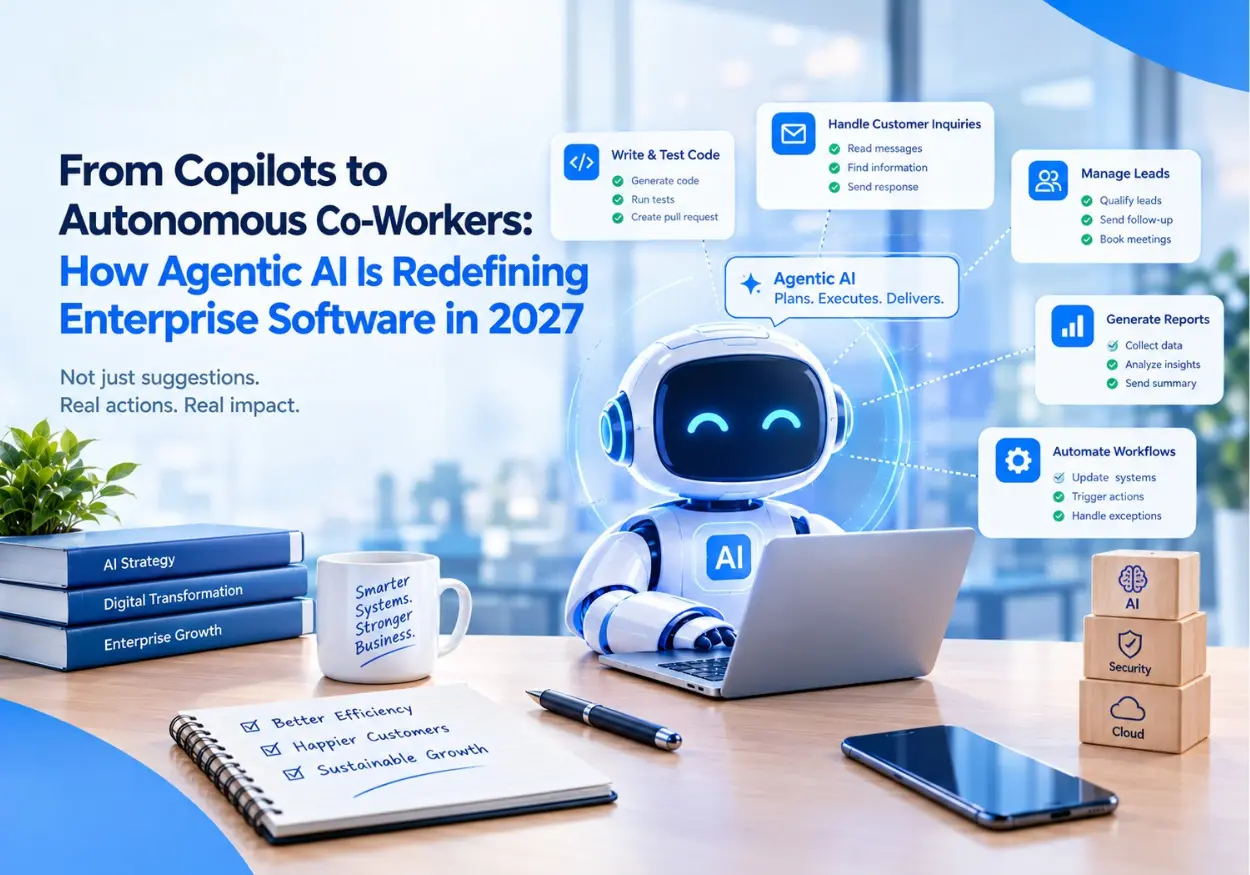
An AI agent is a different category of system. It receives a goal - not a prompt - and executes a multi-step plan to achieve it: reasoning through the approach, selecting tools, taking actions in external systems, handling errors and unexpected states, adapting based on intermediate outputs, and reporting when done. Critically, the human is not in the loop at every step. The agent is.
The practical difference: a copilot helps a developer write a function. An AI agent takes a ticket from the backlog, writes the code, runs the test suite, identifies failures, attempts fixes, and submits a pull request - while your developer works on something else.
In 2027, the competitive advantage shifts from owning an AI chatbot to deploying AI agents that can actually complete work. The architectural requirements that come with that shift are substantial.
The Four Core Components of a Production AI Agent
Understanding what an AI agent is made of is a prerequisite for understanding why scaling it is hard.
1. LLM Reasoning Engine The large language model at the agent's core handles natural language understanding, reasoning through multi-step plans, and deciding which tools to use in what sequence. In 2027, this is increasingly a domain-specific or fine-tuned model rather than a general-purpose foundation model - chosen for higher accuracy on specific workflows and tighter compliance with industry-specific requirements.
2. Tool-Use API Layer An agent that can only produce text is a chatbot. A production agent has access to tools: APIs that let it read and write to your CRM, query your database, execute code, send communications, trigger workflows, and interact with external services. The breadth, reliability, and security of this tool layer determines what the agent can actually do.
3. Memory Management Agents need context. Short-term memory holds the current task's working state. Long-term memory - typically a vector database - holds learned patterns, past interaction summaries, and enterprise knowledge that inform future decisions. Getting memory architecture right is one of the least-discussed and most consequential decisions in agentic system design.
4. Deterministic Guardrails This is the component that separates production agents from demo agents. Guardrails define what an agent is allowed to do, what it must escalate to a human, what constitutes an error state, and how the system behaves when it encounters something it wasn't designed for. The canonical production architecture for 2027 is: agent reasoning → guardrail validation → conditional execution. Without this layer, you don't have a production system. You have an autonomous system without supervision - which is a different and significantly more dangerous thing.
Real-World Enterprise Use Cases That Are Already in Production
The use cases that follow are not hypothetical. They represent the workflows where enterprises are achieving measurable production results with agentic AI in 2026 and 2027.
Automated Code Refactoring and Continuous QA
Moving from human-driven, AI-assisted coding to governed autonomous software delivery compresses feature lead times by 60–80% and fundamentally alters software unit economics.
In production implementations, AI agents are assigned technical debt tickets. They analyze the codebase, identify the scope of the refactoring needed, generate updated code, run the existing test suite against it, identify failures, attempt targeted fixes, and flag anything that requires human architectural judgment before proceeding. The agent doesn't replace the engineering team - it handles the high-volume, low-judgment work that previously consumed senior engineers' time.
The QA layer is where agentic automation delivers particularly consistent ROI. Agents run regression suites continuously, flag regressions the moment they appear, and correlate failures with recent commits - reducing the time between introducing a bug and catching it from days to minutes.
What's required: A clean, well-structured codebase with meaningful test coverage. An agent running QA on a system with poor test coverage doesn't improve quality - it automates the detection of a problem you already have.
Autonomous Customer Onboarding
Enterprise customer onboarding is a multi-system, multi-step process: identity verification, account provisioning, document collection, system access setup, notification workflows, and handoffs between teams. In most enterprises, this process involves human coordination at every step - not because humans are required, but because no system was ever built to connect the steps autonomously.
AI agents change this. A production onboarding agent receives a trigger (new contract signed), initiates identity verification through the relevant API, provisions accounts in the downstream systems based on the contract terms, sends a structured welcome communication, creates the internal project record, and notifies the relevant account team - in sequence, handling exceptions at each step, without human coordination.
The business impact is measurable: onboarding time in days compresses to onboarding time in hours, error rates from manual data entry disappear, and the customer experience of the first interaction with your platform improves immediately.
What's required: Clean API connections between your contract management system, identity provider, provisioning systems, and CRM. Fragmented system integrations are the most common blocker.
Dynamic Supply Chain Adjustment
In supply chain operations, conditions change faster than manual coordination can respond. An AI agent monitoring supply chain signals - inventory levels, supplier lead times, demand forecasts, logistics disruptions - can detect a developing constraint, evaluate alternative sourcing or routing options, execute standard mitigation workflows autonomously, and escalate non-standard situations to a human decision-maker with a structured options brief already prepared.
Deloitte expects agentic automation to fundamentally change how industrial operations are managed by 2027, and supply chain is the vertical where the operational complexity, data availability, and cost of slow human response most clearly justify agentic investment.
What's required: Real-time data feeds from your supply chain systems, clearly defined decision authority thresholds (what the agent can decide vs. what must escalate), and integration with your ERP and procurement systems.
Cross-System Data Synchronization: ERP to CRM
This is the use case that sounds unglamorous and delivers outsized ROI.
In most enterprises, customer and transaction data exists in both ERP and CRM systems - and the two never fully agree with each other. The reconciliation between them is a manual process that someone on your operations team performs periodically, incompletely, and always with some lag.
An AI agent monitors both systems for changes, identifies discrepancies, applies defined reconciliation logic, syncs the correct data to the appropriate system, and flags conflicts that the logic can't resolve for human review. The agent runs continuously. The data stays consistent. The operations team member who previously spent hours on reconciliation gets those hours back.
Model capability is no longer the differentiator in agentic AI. Data onboarding, integration, and governance are ERP-to-CRM sync is one of the clearest demonstrations of that principle in practice.
The Architectural Challenge: Why Pilots Stall and Production Breaks
88% of AI proofs of concept never reach widescale deployment, according to IDC. The reasons are stubbornly consistent across industries, company sizes, and AI maturity levels. Understanding them is the prerequisite for avoiding them.
The Data Problem
83% of organizations believe their existing infrastructure is not ready to support production-scale agentic AI. The core issue is that agents need unified, clean, real-time access to enterprise data - and most enterprise data environments are the opposite of that: fragmented across systems, inconsistently structured, batch-updated rather than real-time, and accessed through a tangle of legacy integrations.
IDC predicts that by 2027, companies that do not prioritize high-quality AI-ready data will struggle to scale GenAI and agentic solutions, resulting in a 15% productivity loss. The path to production-grade agentic AI runs through data architecture, not model selection.
The Governance Gap
While 84% of enterprises consider security and compliance non-negotiable, 60% report early-stage or nonexistent AI governance frameworks.
Governance gaps drive agentic sprawl. More than half of enterprises report it even after adopting the NIST AI Risk Management Framework - because a policy document can't control an autonomous, tool-invoking system.
Governance for agentic AI is not a document. It is an operational architecture: runtime controls that determine what actions an agent is authorized to take, audit logging that creates a complete record of what each agent did and why, rollback mechanisms for when an agent takes an incorrect action, and escalation protocols that route ambiguous situations to human judgment before committing to an irreversible step.
Gartner's updated warning: by 2027, 40% of enterprises will demote or decommission autonomous AI agents - not over cost, but because governance gaps only surface after a production incident. The incidents, in other words, are the audit. Building governance before deployment is how you avoid using production users as your test environment.
The Infrastructure Bottleneck
Organizations planning their 2027 cloud budgets must account for the compute multiplier of agentic workloads or risk infrastructure bottlenecks that prevent agents from scaling beyond pilot deployments.
A chatbot handles discrete, short interactions. An AI agent runs continuous, long-horizon tasks - potentially for hours, days, or longer. A long-running agent doesn't behave like a chatbot. It behaves like a distributed system and distributed systems demand orchestration, identity, and context discipline that most companies have never built.
The infrastructure implications: low-latency model inference for fast decision-making, scalable vector databases for agent memory, robust API gateway management for tool access, real-time observability across all agent actions, and compute budgeting that accounts for the workload profile of continuous autonomous execution rather than discrete prompt-response cycles.
The Identity and Permissions Problem
AI agents need identities. When an agent accesses your CRM, updates a record, triggers a workflow, or sends a communication, that action needs to be attributable to a specific agent identity - with defined permissions, logged actions, and revocable access.
Traditional identity and access management was designed for human users with discrete login sessions. It was not designed for autonomous systems operating continuously across multiple tools simultaneously. Organizations getting agent deployment right in 2026 have converged on a unified data layer that agents query through governed interfaces - not direct database access. That architectural decision - governed API access rather than direct system access - is what makes agent identity and auditability manageable.
What MLOps 2.0 Actually Means for Agentic Systems
MLOps 1.0 was about managing the lifecycle of ML models: training pipelines, versioning, deployment, monitoring, retraining. It was built around models that produced predictions or classifications from structured inputs.
Agentic systems break most of those assumptions. An AI agent is not a model producing a prediction. It is a system that reasons, plans, selects tools, executes actions, handles errors, and adapts in real time. Its "outputs" are not classifications - they are real-world actions in your production systems.
MLOps 2.0 for agentic systems requires:
Agent observability - not just model performance metrics, but a complete audit trail of every reasoning step, every tool call, every action taken, and every decision point in the agent's execution. In 2026, IBM introduced AI Agent and LLM Observability specifically to improve visibility into production AI systems as agents interact with APIs, data pipelines, and enterprise services.
Behavioral testing - testing that validates not just that the agent produces correct outputs in controlled test cases, but that it handles edge cases, adversarial inputs, and unexpected system states without taking actions outside its defined boundaries.
Continuous evaluation - ongoing measurement of agent accuracy, escalation rates, task completion rates, and error frequencies across production traffic, with feedback loops that inform prompt tuning and guardrail updates.
Graceful degradation - defined fallback behavior when a component of the agent stack is unavailable: the model API, a tool integration, or the memory system. Production agents that fail silently create worse outcomes than agents that escalate visibly.
Human-in-the-loop orchestration - not for every action, but for every category of action where the cost of an incorrect autonomous decision exceeds the cost of a brief human review. Defining these categories before deployment, not after an incident, is the governance work that determines whether your agentic system builds organizational trust or erodes it.
How InfiniTechX Helps Enterprises Build Future-Ready Agentic Systems
The engineering work required to move from an agentic AI pilot to a production system is substantial - and it is the kind of work that rewards deep experience over fresh enthusiasm.
InfiniTechX Technologies works with enterprise technology teams to design and build the systems that agentic AI runs on: AI agent development and integration, scalable backend engineering, cloud modernization for AI workloads, and the data integration layer that determines whether your agents have the clean, unified, real-time access to enterprise data they need to function reliably.
Their engineering approach is designed around the specific challenges that make agentic AI projects fail:
Data readiness assessment before any agent architecture is designed - identifying where your data is fragmented, inconsistent, or insufficiently real-time to support production agent execution
Governance framework design that translates policy into runtime controls - defining agent identities, permissions, escalation paths, and audit logging as architectural requirements, not post-deployment additions
Infrastructure architecture that accounts for the compute, latency, and observability requirements of agentic workloads - not chatbot workloads
Phased deployment models that move from single-workflow agent to multi-workflow to multiagent coordination in stages - each stage validated against production metrics before the next is initiated
For enterprises that have a pilot running but haven't been able to scale it, InfiniTechX's team can assess why - and design the architectural changes needed to turn a successful proof of concept into a production system.
For enterprises that are earlier in the journey, they help define the right first use case, the right architecture, and the right sequence to move from design to production in the shortest responsible timeline.
Frequently Asked Questions
What is the difference between a copilot and an autonomous AI agent? A copilot is a prompt-response AI system embedded in an existing tool. You provide input; it generates output; you decide what to do with it. An autonomous AI agent receives a goal, reasons through a plan to achieve it, executes multi-step actions in external systems, handles errors and unexpected states, and reports when complete - without requiring human input at each step. The distinction is not one of degree but of kind: copilots assist human work, agents perform it.
Why do most enterprise AI agent projects fail to reach production? The three most consistent failure modes are data architecture gaps (agents can't access clean, unified, real-time enterprise data), governance absence (no runtime controls over what agents are authorized to do), and infrastructure underestimation (the compute, latency, and observability requirements of agentic workloads are significantly higher than chatbot workloads). Model quality is rarely the issue. The surrounding system is.
What is MLOps 2.0 for agentic AI? MLOps 2.0 extends traditional model operations practices to cover the lifecycle of agentic systems - which behave as distributed systems rather than prediction APIs. It includes agent observability (full audit trails of reasoning and actions), behavioral testing (edge case and adversarial validation), continuous evaluation of production agent performance, graceful degradation design, and human-in-the-loop orchestration for high-stakes decision categories.
How do you govern an AI agent in production? Governance for a production AI agent is operational architecture, not documentation. It includes: defined agent identities with specific permissions (governed API access, not direct database access), complete audit logging of every action taken, confidence-based escalation thresholds that route uncertain situations to human review, rollback mechanisms for incorrect actions, and ongoing monitoring of agent behavior against defined performance and safety metrics.
How long does it take to move an AI agent from pilot to production? For a single, well-scoped workflow with clean data and defined success metrics, a production deployment can be achieved in 12 to 20 weeks. The timeline is driven primarily by data readiness and integration work, not model development. Enterprises with fragmented data environments or absent governance frameworks should plan for a foundational phase before agent development begins - typically 6 to 10 weeks of data assessment, architecture design, and governance framework establishment.
What should an enterprise do first before building an AI agent? Three things, in order: audit your data environment (identify which systems the agent needs to access and whether that data is clean, consistent, and API-accessible), define your governance framework (what the agent is authorized to do, what it must escalate, and how you will monitor it in production), and choose the right first use case (high volume, well-defined workflow, with a clear baseline metric that will let you measure the agent's actual impact).
The Window for Agentic Advantage Is Open - But Narrowing
According to Forrester, 25% of planned AI spend will be deferred by 2027 due to ROI concerns.That deferral is not evidence that agentic AI doesn't work. It is evidence that the enterprises that started without the right foundations are discovering - after the investment - that the foundation mattered more than the model.
The 2026 agentic AI landscape paints a clear picture: production is now the baseline, not the goal. The next phase of agentic AI adoption will be defined by how well organizations address data readiness, formalize governance, and operationalize ROI at scale.
The engineering leaders who move from pilot to production in 2027 are not the ones who found a better model. They are the ones who built the data architecture, governance framework, and infrastructure that let their agents run reliably at scale - and who chose development partners who understood that the hard part was never the AI.
If that is the problem you're working on, InfiniTechX Technologies would like to be part of that conversation.
Recent Post
Browse all postFrom Copilots to Autonomous Co-Workers: How Agentic AI Is Redefining Enterprise Software in 2027
Top 20 Technology Trends in 2027 That Will Shape the Future of Business