
Is 2026 the Year Your Business Finally Needs an AI Agent?
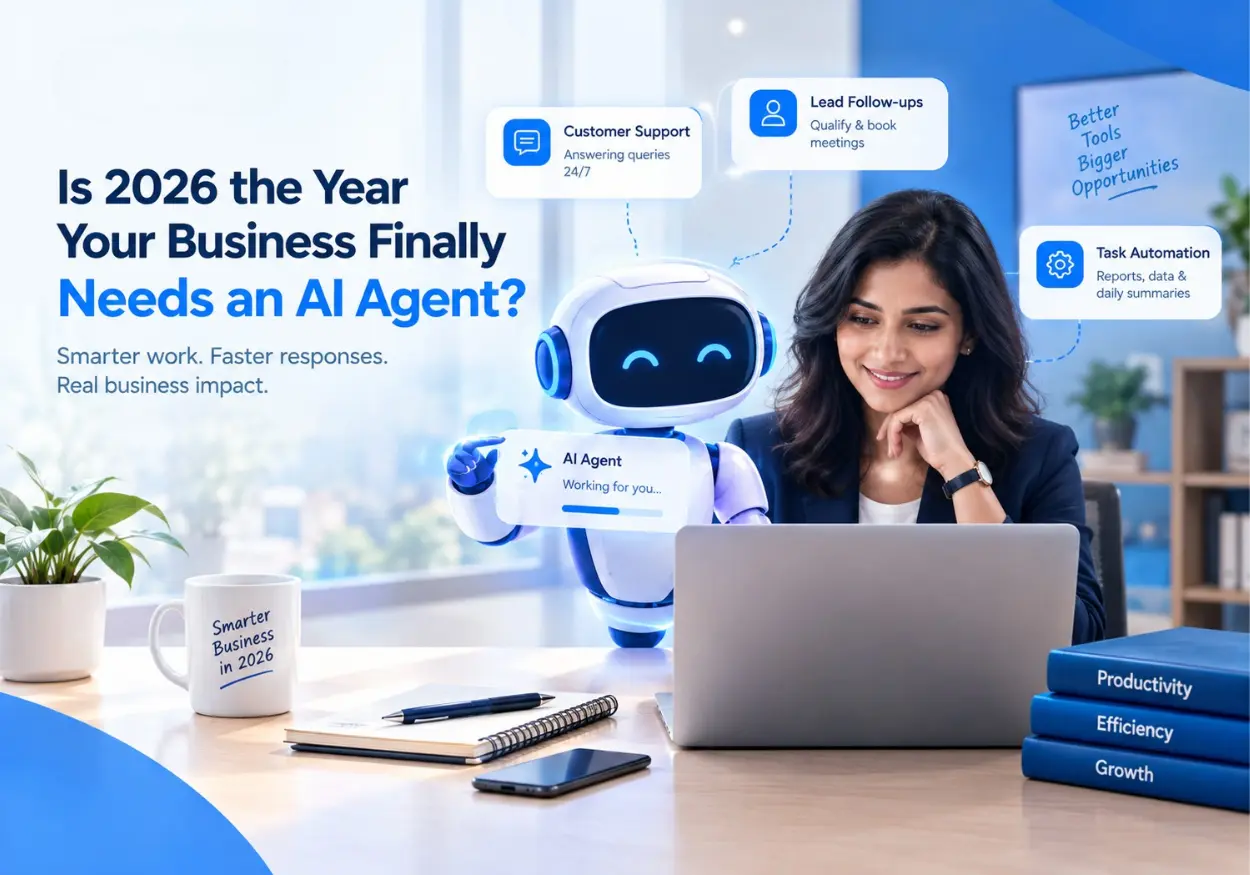
Let's be real - if you've been hearing the words "AI agent" everywhere lately and quietly wondering whether it's something you actually need or just another tech buzzword you can safely ignore, you're not alone.
Most business owners are in exactly the same place right now. They're curious. They've seen the headlines. They've watched competitors experiment. And they're trying to figure out whether this is the moment to pay attention - or whether it's still too early, too complicated, or too expensive for a business like theirs.
This article is written for you. Not for developers. Not for CTOs. For the business owner who runs a real operation, has real customers, and wants a straight answer about whether AI agents are actually relevant to their life right now.
Spoiler: for most businesses in 2026, the answer is yes. But the how matters more than the yes - and that's what this guide is really about.
First, Let's Be Honest About What's Actually Happening With AI Right Now
There's a lot of noise around AI. Some of it is genuinely exciting. Some of it is marketing hype dressed up in technical language. It can be hard to tell which is which.
Here's the honest picture: AI has spent the last few years mostly helping individuals work faster - drafting emails, generating images, summarizing documents. Useful, but incremental.
What changed in 2025 and accelerated into 2026 is different in kind, not just degree. AI systems are no longer just tools you prompt and respond to. They're increasingly systems that work on your behalf - independently, continuously, across multiple tasks - without you having to be in the loop for every step.
That shift is what "agentic AI" means. And it's why business owners who ignored AI two years ago are paying close attention today.
So What Exactly Is an AI Agent? (No Jargon, Promise)
An AI agent is software that can take action on your behalf - not just produce an answer, but actually do things.
Think about the difference between asking someone a question and hiring someone to handle a task. A regular AI tool is like asking a question. An AI agent is like hiring someone who understands what you need, goes and handles it, and reports back - or just quietly takes care of it while you're doing something else.
Practically speaking, an AI agent might:
Read an incoming customer message, understand what they're asking, pull the relevant information from your system, and send back a complete, accurate response
Notice that a lead filled out a form on your website, score them against your criteria, send a personalized follow-up, and book a meeting directly into your calendar
Pull data from three different places in your business, compile a weekly summary, and send it to you every Monday morning before you've even had coffee
None of these require a human to initiate each step. The agent runs the process. You get the output.
Why Are AI Agents Such a Big Deal in 2026 Specifically?
Fair question - AI has been "the future" for a while. Why does 2026 feel different?
A few things converged this year that moved AI agents from experimental to practical:
The technology matured. Early AI tools were impressive but unreliable - useful for low-stakes tasks, risky for anything that mattered. The underlying models running today's AI agents are significantly more accurate, more consistent, and better at handling the variation and messiness of real business situations.
Integration became much simpler. A year ago, connecting an AI agent to your existing CRM, email system, or calendar required significant technical work. Today, most AI agent platforms connect to common business tools out of the box - without requiring a development team.
The cost dropped to accessible levels. Enterprise AI budgets are no longer the only entry point. Targeted AI agent deployments for specific workflows are within reach for small and mid-sized businesses - and the ROI timeline has shortened significantly.
The gap is opening. Businesses that have deployed AI agents are operating faster, responding to customers quicker, and scaling without proportional headcount increases. Businesses that haven't are beginning to feel that gap. 2026 is the year that gap started mattering competitively.
What Can an AI Agent Actually Do for a Business Like Yours?
Let's skip the abstract and get concrete. Here are the tasks where AI agents are delivering real, measurable value for small and mid-sized businesses right now:
It Can Answer Your Customers at 2 AM - Without You
Customer questions don't stop when your team goes home. An AI agent connected to your website or messaging channels can handle inquiries around the clock - answering questions about your services, helping with common issues, collecting information from potential customers - and handing off to a human when something genuinely needs one.
The result isn't just convenience. Businesses that respond to customer inquiries within five minutes are dramatically more likely to convert them. An AI agent makes that five-minute response possible at any hour, on any day.
It Can Follow Up With Leads You'd Otherwise Forget
Here's an uncomfortable truth most business owners recognize: leads fall through the cracks. Someone fills out a form, something comes up, the follow-up doesn't happen until three days later, and by then they've moved on.
An AI agent follows up immediately, consistently, and patiently - asking the right qualifying questions, sending the right information, and booking calls with prospects who are ready - without anyone on your team having to remember to do it.
It Can Handle the Admin Work Nobody Wants to Do
Data entry, report compilation, internal notifications, scheduling coordination, status updates — these tasks exist in every business, consume meaningful time, and don't actually require human judgment to complete. They just require someone - or something - to do them reliably.
This is where AI agents quietly pay for themselves. The hours your team was spending moving information from one place to another get redirected to work that actually needs them.
It Can Give You Data You Didn't Know You Were Missing
AI agents that interact with customers or manage workflows collect information as they operate. What questions are people asking most frequently? Where in your sales process are prospects going quiet? Which types of customer requests take longest to resolve?
That data - which previously lived in scattered inboxes and spreadsheets - becomes visible and usable. Better information leads to better decisions. And better decisions compound over time.
Signs Your Business Is Ready for an AI Agent
You don't need to be a large company or a tech startup to benefit from an AI agent. But there are signals that suggest the timing is right:
Your team is handling the same types of requests over and over. If your inbox or support queue is full of similar questions that require similar answers, that repetition is automatable.
Response time is affecting your customer experience or conversion rate. If customers or leads are waiting hours for a response that should take minutes, an AI agent closes that gap immediately.
You're growing faster than you can hire. If demand is increasing but adding headcount for every new workflow isn't sustainable, AI automation extends your team's capacity without adding to your payroll.
You're losing track of follow-ups and tasks. If things are slipping through the cracks because nobody has time to stay on top of them, an AI agent doesn't forget and doesn't get busy.
You spend time on reports, updates, or coordination that feels mechanical. If you can describe a task in a clear set of steps, there's a reasonable chance an AI agent can handle it.
Signs You're Not Quite Ready Yet - And That's Okay
Honest advice: AI agents aren't the right move for every business at every stage. Here's when it makes sense to wait:
Your workflows aren't defined clearly yet. AI agents automate processes — so the process has to exist and be understood before it can be automated. If your operations are still ad hoc, define them first.
Your data is scattered and inconsistent. AI agents work with your data. If that data lives in disconnected places in inconsistent formats, some groundwork is needed before automation adds value.
You're looking for AI to solve a business problem that isn't actually operational. AI agents handle tasks and workflows. They don't fix product-market fit, pricing strategy, or brand positioning. Know what you're actually solving for.
Being not-ready-yet isn't a failure. It's useful information. It tells you what to work on so that when you do deploy an AI agent, it actually works.
"But I'm Not a Tech Person" - You Don't Have to Be
This might be the most important thing in this article for a lot of readers.
You do not need to understand how AI works to use it in your business. You need to understand your own workflows - which you already do better than anyone.
The technical side of building, integrating, and deploying an AI agent is handled by a development partner. Your job is to be able to describe what you do, what's repetitive, and what a good outcome looks like. That's a business conversation, not a technical one.
The business owners getting the most from AI agents in 2026 aren't the most technically sophisticated. They're the ones who were most honest and specific about their actual operational pain points.
What Does It Actually Cost in 2026?
Cost is one of the most searched questions in this space - and one of the most poorly answered. Here's a realistic picture:
The cost is real — but so is the return. Businesses consistently find that a well-scoped AI agent deployment pays back within 6 to 18 months through labor hours saved and revenue recovered from faster response times and follow-up rates.
The Honest Truth About What AI Agents Can't Do
No guide on AI agents would be complete - or trustworthy - without this section.
AI agents are very good at defined, repeatable tasks with clear inputs and outputs. They are not good at:
Judgment calls that require genuine human empathy. A customer in distress needs a person. An AI agent can recognize the escalation signal and hand off, but it shouldn't try to replace the human moment that follows.
Creative strategy. AI can execute a process. It cannot decide what your business should stand for, which market to enter, or how to position against a competitor.
Tasks where the rules change constantly without notice. AI agents work best in environments where workflows are stable. If your process changes every week, the maintenance overhead can outweigh the benefit.
Building relationships. Trust, rapport, and the kind of loyalty that makes customers stay and refer others - those come from human interaction. AI agents handle the volume so your humans can focus on the relationship.
Understanding these limits isn't a reason to avoid AI agents. It's a reason to deploy them where they're strong and protect the human touchpoints that matter most.
Frequently Asked Questions
Is 2026 too early or too late to start with AI agents? Neither. 2026 is the practical entry point for small and mid-sized businesses - the technology is mature enough to be reliable, accessible enough to be affordable, and early enough that you're not playing catch-up from years behind. Businesses that start now have a meaningful window to build operational advantages before the gap closes.
Do AI agents replace employees? The businesses seeing the best results from AI agents aren't using them to reduce headcount. They're using them to stop their existing teams from spending time on repetitive, low-judgment tasks — freeing those people for work that actually needs a human. The typical outcome is the same team handling more, better, with less friction.
What's the first workflow I should automate? Start with the one that is highest in volume, most consistent in how it runs, and most painful when it doesn't happen on time. For most businesses, that's either customer inquiry response or lead follow-up. Both deliver fast, visible ROI.
How long does it take to get an AI agent running? A focused, single-workflow deployment can be live in 6 to 10 weeks. Broader multi-workflow systems typically take 3 to 5 months across a phased rollout. The timeline is driven by integration complexity, not AI complexity.
Will my customers know they're talking to an AI? That's a business decision, not a technical one. AI agents can be designed to disclose their nature transparently or to operate as a business's support function without emphasizing the technology. Most businesses are moving toward transparency - and customers are increasingly comfortable with AI-assisted responses as long as the quality is good and escalation to a human is available when needed.
Where to Go From Here
If you've been sitting on the fence about AI agents - curious but not sure the timing was right - 2026 is a reasonable year to get off the fence.
Not because of the hype. Because the technology works, the costs are accessible, and the businesses that delay are beginning to feel it in their response times, their follow-up rates, and their team bandwidth.
The starting point isn't a technology decision. It's a conversation about your workflows - which ones eat the most time, which ones are the most consistent, and which ones you'd most like to never have to do manually again.
That's the conversation InfiniTechX Technologies has with business owners every day. Their AI Agent team works with businesses at every stage of AI readiness - from "I have no idea where to start" to "I know exactly what I want to automate, I just need the right partner to build it." Their AI Agent service is built specifically for businesses that want results, not experiments.
If you're ready to have that conversation, they offer a free, no-commitment AI strategy session where their team will look at your specific workflows and give you an honest picture of where AI automation would actually make a difference for your business.
Recent Post
Browse all postIs 2026 the Year Your Business Finally Needs an AI Agent?
MVP vs. Finished Product: What's the Difference and Which One Do You Actually Need?
