
MVP vs. Finished Product: What's the Difference and Which One Do You Actually Need?
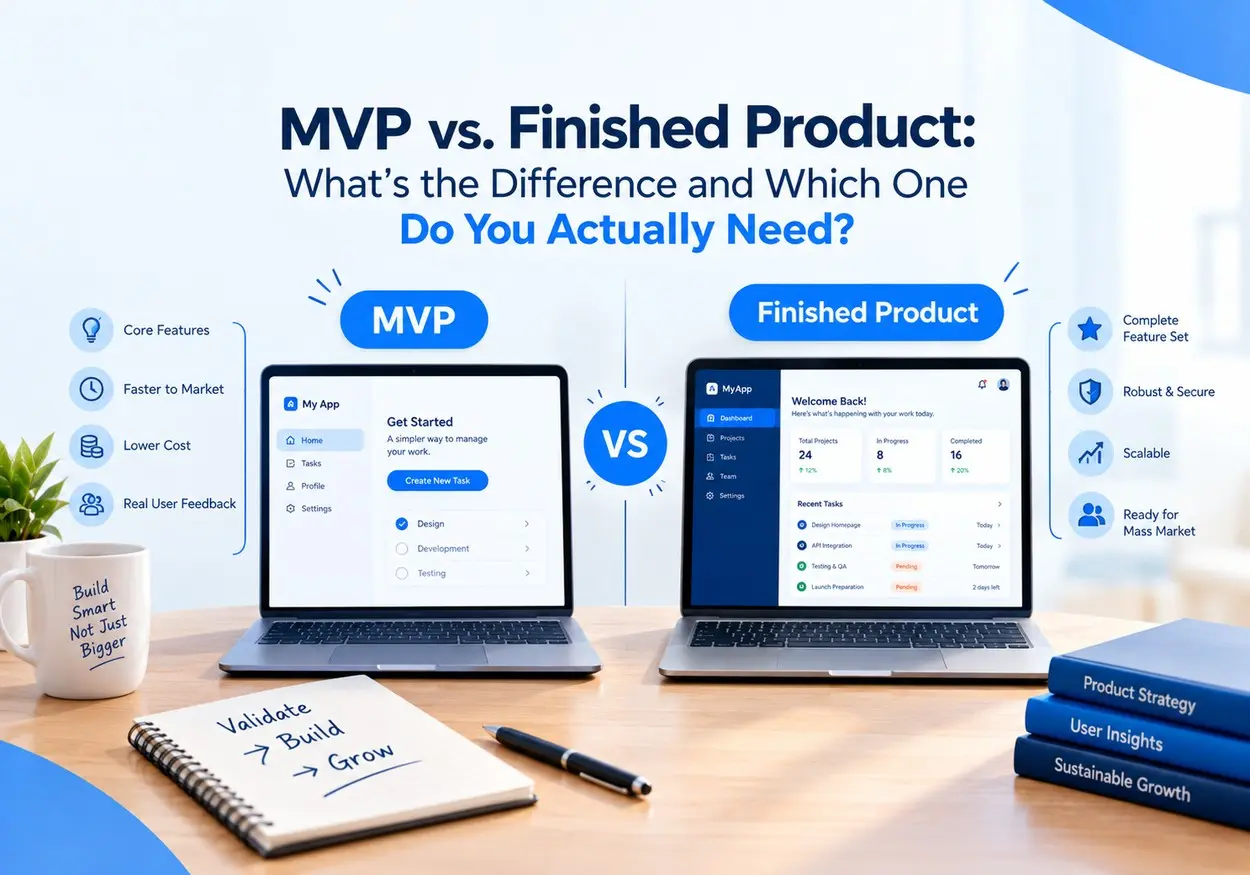
You have a product idea. You're weighing your options: build it fully now, or build a smaller version first. You've heard the term MVP, but you're not entirely sure whether it means a rough prototype, a stripped-down app, or something else entirely.
What Is an MVP, in Plain Terms?
MVP stands for Minimum Viable Product. Despite what the name might suggest, the key word isn't "minimum" - it's "viable."
An MVP is the smallest version of a product that can be put in front of real users and deliver genuine value. It includes only the features that are essential to solving the core problem the product was built to address. Everything else - the additional features, the polished interface, the integrations, the edge case handling - comes later, after real users have interacted with the product and told you what they actually need.
The goal of an MVP is not to ship something cheap or unfinished. It is to learn as quickly and inexpensively as possible whether your product solves a real problem for real people in the way you think it does - before spending the full budget on a product built entirely on assumptions.
What Is a Finished Product?
A finished product - sometimes called a full product or production-ready product - is a complete, polished version of software that is built to its full intended specification. It includes all planned features, a refined user experience, robust performance and security architecture, comprehensive testing, and the infrastructure to support ongoing operations and growth.
A finished product is what you build when you have validated what users want, how they want it, and what the product needs to do to compete and retain users over time. It is the destination - not the starting point.
What Is the Actual Difference Between an MVP and a Finished Product?
This is the question most business owners ask - and the answer is more nuanced than "one is smaller than the other."
The critical distinction: an MVP is a learning tool. A finished product is a market tool. You use an MVP to find out whether you're building the right thing. You build a finished product once you know you are.
Is an MVP the Same as a Prototype?
No - and this is one of the most common points of confusion.
A prototype is a simulation of a product, typically used to test design concepts and user flows before building anything functional. It might be a clickable mockup, a set of wireframes, or an interactive design file. It looks like a product but doesn't actually work. No real data is stored, no real logic runs, no real actions are executed.
An MVP is a working product. Users can create accounts, complete workflows, store data, and receive real outputs. The difference is that it only does the essential things — it doesn't do everything the finished product will eventually do.
Think of it this way: a prototype answers "does this design make sense?" An MVP answers "does this product actually solve the problem?"
Both have value, but they answer different questions at different stages.
Why Build an MVP Before a Full Product?
There are four situations where building an MVP first is clearly the right decision:
You Don't Know Exactly What Users Want Yet
Every product starts with assumptions. You assume users need a particular feature. You assume they'll navigate the product a certain way. You assume the core value you're offering is the value they're actually looking for.
Some of those assumptions will be right. Some will be wrong. And the ones that are wrong - if discovered after a full product build - cost significantly more to fix than if they had been discovered in an MVP with a fraction of the features.
The MVP surfaces those wrong assumptions early, when the cost of changing course is still low.
You Want to Reduce Financial Risk
The financial case for an MVP is straightforward: you invest less before you know whether the product direction is right. If the MVP validates your concept, you proceed with confidence. If it reveals that users want something different, you redirect before committing the full budget to the original direction.
Building a full product before any user validation is a large bet placed entirely on assumptions. Building an MVP first is how you gather evidence before making that bet.
You Need to Move Faster Than a Full Build Allows
Time to market matters. In most markets, being first to prove a concept - even with a limited product - creates advantages in user acquisition, investor attention, and competitive positioning that are difficult to recover if you arrive late with a more complete product.
An MVP gets something real into the market in weeks or months rather than years. That speed has strategic value beyond just the validation it enables.
You're Seeking Investment or Early Customers
For most investors and early enterprise customers, a working product - even a limited one - is significantly more persuasive than a pitch deck or a prototype. An MVP demonstrates that the team can ship, that the concept is technically feasible, and that real users can interact with the product and find value in it.
If fundraising or early sales are on your near-term roadmap, an MVP is often the most efficient asset you can build to advance those conversations.
When Does It Make Sense to Skip the MVP?
MVP-first is not the right approach in every situation. There are cases where building toward a more complete product from the start is the better decision:
When the requirements are fully defined and validated. If you've already run extensive user research, have committed customers waiting for the product, and have high confidence in exactly what needs to be built, an MVP stage may add timeline without adding useful learning.
When you're building an internal tool with a captive user base. If the product is for your own team or organization - and the users don't have the option to churn - the iterative validation model of an MVP matters less. You can build more completely because the feedback loop is already controlled.
When regulatory or compliance requirements demand a complete build. In some industries - financial services, healthcare, regulated government systems - launching a partial product isn't possible. The compliance requirements define a minimum feature set that is higher than what an MVP would typically include.
When competitive differentiation depends on completeness. In markets where users compare products feature-by-feature against established alternatives, a limited MVP may fail to demonstrate enough value to gain adoption, even among early adopters. In these situations, the competitive threshold is higher than what an MVP clears.
What Should - and Shouldn't - Go Into an MVP?
Scope definition is where most MVP projects either succeed or fail before development even starts. Getting this wrong in either direction - too much or too little - undermines the purpose of building an MVP at all.
What should go in:
The single core workflow that delivers your product's primary value
The authentication and account management users need to access that workflow
Enough reliability and stability to support real usage without frequent failures
Basic data collection so you can measure what users are doing
What should stay out:
Secondary features that enhance the core but aren't required for it
Advanced customization or settings options
Integrations with third-party tools that aren't essential to the core workflow
Polished animations, micro-interactions, and visual refinements
Comprehensive edge case handling and error states
Admin dashboards and internal tooling beyond the minimum needed to operate
A useful test for each feature under consideration: "Can a user get real value from this product without this feature?" If the answer is yes, it doesn't belong in the MVP. Defer it to v1.1.
How Long Does It Take and What Does It Cost?
Timeline and cost vary based on the complexity of the core workflow, the platform (web, iOS, Android, or cross-platform), and the backend requirements — but here are realistic reference points for planning:
These ranges assume a professional development partner handling design, engineering, and QA. DIY or freelancer builds can cost less upfront but frequently produce technical debt that makes the next iteration significantly more expensive.
What Happens After the MVP Launches?
The MVP launch is not the finish line - it is the starting point for the product's real development cycle.
Once real users are interacting with the product, three things happen simultaneously:
You get data. Which features are being used? Where are users dropping off? How long are they staying in each session? What actions precede cancellation or inactivity? This behavioral data is more reliable than any pre-launch assumption.
You get feedback. Through support messages, reviews, user interviews, and surveys, you learn what users find valuable, what confuses them, and what they wish the product could do. Some of this will confirm your assumptions. Some will surprise you.
You make decisions. Based on data and feedback, you prioritize: what to fix, what to add, what to remove, and what direction to take the product in next. The roadmap for v2 is built almost entirely from what you learn in the MVP phase - which is why the MVP phase exists.
The iteration cycle - launch, measure, learn, build - is what separates products that improve consistently from products that stagnate after the initial release.
The Most Common MVP Mistakes Business Owners Make
Even with good intentions, MVP projects frequently go wrong in predictable ways:
Building too much. Scope creep in an MVP defeats its purpose. Every feature added beyond the core extends the timeline, increases the cost, and delays the learning that the MVP was designed to produce. Ruthless scope discipline is the most important skill in MVP development.
Building too little. An MVP that doesn't deliver genuine value won't produce useful feedback - because users won't engage with it long enough to tell you anything meaningful. "Minimum" doesn't mean unusable. It means focused.
Skipping user research before building. An MVP built on unvalidated assumptions about who the user is and what they need is still a risky investment, just a smaller one. Talking to real potential users before and during development is what ensures the MVP tests the right hypothesis.
Treating the MVP as the finished product. Once an MVP is live, the temptation to keep patching and extending it rather than rebuilding on a stronger foundation can result in a product that outgrows its original architecture without ever getting properly rebuilt. Know when the MVP has served its purpose and plan the transition to a full build accordingly.
Not defining success before launch. If you don't decide in advance what "validated" looks like - what metrics, what user behaviors, what feedback signals would tell you the concept works - you can't make a clear decision after launch. Define your success criteria before the first line of code is written.
Frequently Asked Questions
Is an MVP a real product or just a demo? An MVP is a real, working product — not a demo or simulation. Real users can interact with it, complete workflows, and store data. The difference from a finished product is scope: an MVP includes only the features essential to delivering core value. Everything else is deferred until after real-world validation.
Can I use no-code tools to build an MVP? Yes, for the right type of MVP. No-code platforms like Bubble, Webflow, or Glide can build a working MVP quickly and at lower cost for simple web tools, internal dashboards, and straightforward customer-facing applications. They have meaningful limitations around complex business logic, performance at scale, and deep system integrations. For products where these factors matter from day one, custom development — even for the MVP - is usually the right choice.
How do I know when my MVP is ready to launch? Your MVP is ready to launch when it can deliver the core value proposition to a real user, end to end, without requiring workarounds or human assistance. It doesn't need to be perfect. It needs to be functional enough for real users to complete the primary workflow and give you meaningful feedback. If users can't complete the core workflow, it's not ready. If they can, it is.
Should my MVP look polished? It should look credible - professional enough that users take it seriously and engage honestly with it rather than dismissing it as unfinished. It does not need to be visually refined or pixel-perfect. The investment in full visual polish belongs in the finished product, after the MVP has validated what needs to be built.
What's the biggest risk of skipping the MVP stage? The biggest risk is building the wrong thing at full cost. Without real user validation, your full product build is based entirely on assumptions. Some will be right. The ones that are wrong will require rework - and rework on a completed product is far more expensive than course-correcting during or after an MVP. The MVP exists to catch those wrong assumptions before they become expensive problems.
What to Do Next
If you're standing at the decision point - build the full product now or start with an MVP - the answer for most business owners with a new product idea is clear: start with the MVP.
Not because it's cheaper. Because it's smarter. The validated learning an MVP produces doesn't just reduce financial risk - it produces a better finished product, because every major decision in the full build is informed by real user behavior rather than pre-launch assumptions.
The most important thing is not which option you choose - it's that you go into it with a clear scope, a defined success metric, and a development partner who understands that the MVP's job is to produce learning, not just to ship something.
InfiniTechX Technologies builds MVPs for founders and business owners at exactly this stage - from idea scoping through prototyping, development, launch, and the iteration cycle that follows. Their MVP development team works across industries including startups, fintech, healthtech, e-commerce, and SaaS, delivering working products in weeks rather than months.
If you're ready to talk through what your MVP should include - and what it should leave out - their team offers a free scoping session with no commitment required.
Recent Post
Browse all post
Is 2026 the Year Your Business Finally Needs an AI Agent?
MVP vs. Finished Product: What's the Difference and Which One Do You Actually Need?
