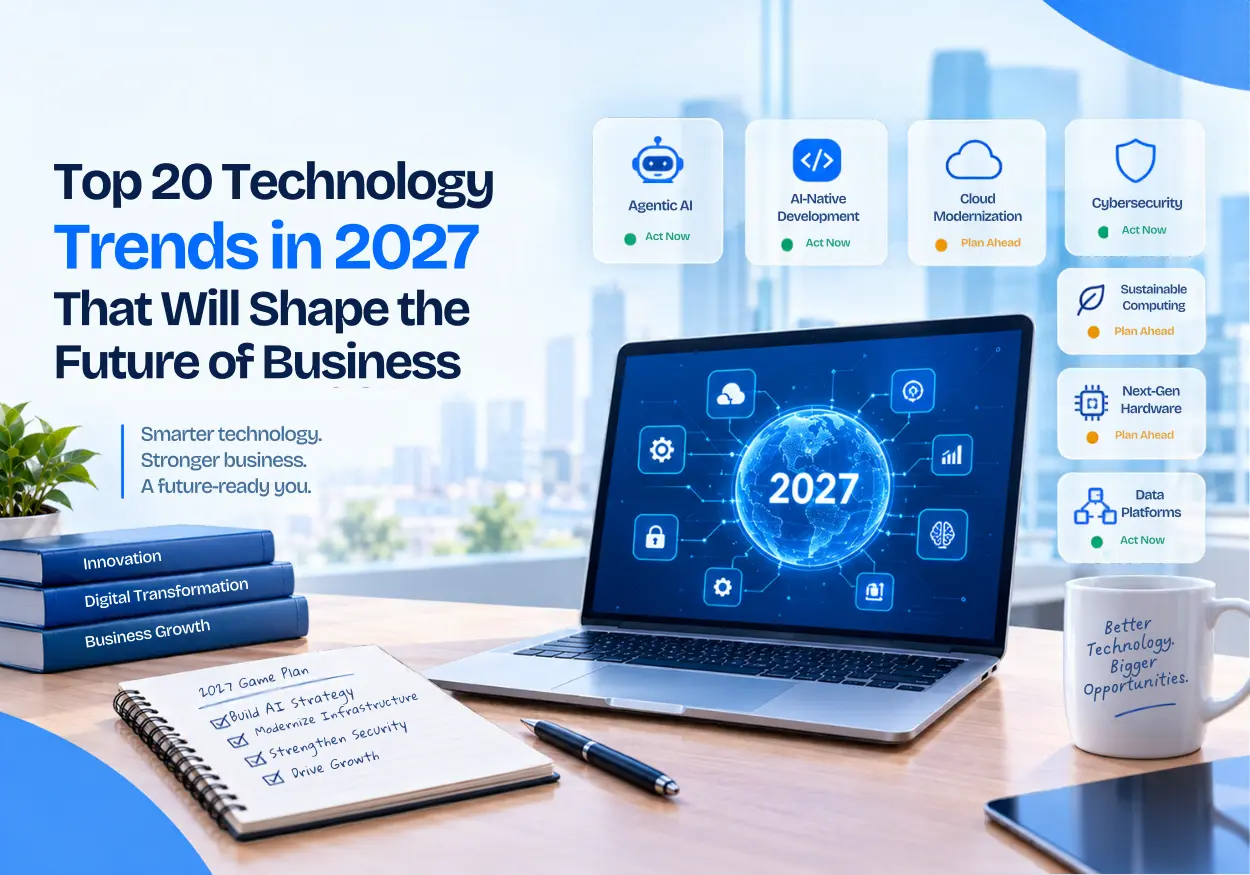
Top 20 Technology Trends in 2027 That Will Shape the Future of Business
What Are the Most Important Technology Trends Businesses Should in 2027?
The most important technology trends for businesses in 2027 center on one fundamental shift: AI is moving from a tool you prompt to a system that acts. Agentic AI, autonomous software development, domain-specific models, and AI-native infrastructure are converging into a new operational reality - one where businesses that have built solid data foundations and clear governance frameworks will pull ahead of those still treating AI as an experiment. Beyond AI, cybersecurity is evolving into a design constraint rather than a checklist, cloud modernization is being reframed as an AI readiness requirement, and sustainable computing is moving from optional to expected. This article covers all 20 trends shaping 2027, with honest analysis of what they mean for growing businesses and what to consider before acting on any of them.
A Note on How to Read This List
Not every trend on this list is relevant to every business right now. Some are enterprise-scale shifts that filter down to small and mid-sized businesses over 12 to 24 months. Others are immediately actionable regardless of company size or technical maturity.
Throughout this article, each trend is labeled with a practical adoption signal for growing businesses:
🟢 Act now - Relevant and actionable for most businesses in 2027
🟡 Plan ahead - Not urgent today, but worth understanding and preparing for
🔴 Monitor - Important at enterprise or industry scale; most SMBs can watch without acting yet
The source of each trend is clearly identified. Analysis sections represent InfiniTechX's interpretation of published findings, not the findings themselves.
The 20 Technology Trends Shaping Business in 2027
1. Agentic AI - From Assistant to Autonomous Operator 🟢
What the research says: Gartner identified agentic AI as a top strategic technology trend, noting that by 2027 the competitive advantage will shift from owning an AI chatbot to deploying AI agents that complete actual work - multi-step processes with tools, permissions, and measurable outcomes. IDC predicts that 40% of job roles at large global enterprises will involve working with AI agents by 2027.
What this means for your business: An AI assistant answers questions. An AI agent books the meeting, updates the CRM, sends the follow-up, and files the report - while you're doing something else. The gap between businesses using AI agents and those using AI chatbots is beginning to look like the gap between businesses using email and those still relying on fax. For growing businesses, the most accessible entry point in 2027 is single-workflow agents: one focused process automated end to end.
Before you adopt: Audit whether your data is clean and connected enough to support an agent. An agent working on fragmented data produces fragmented results, faster.
2. Multiagent AI Systems - When AI Teams Up With Itself 🟡
What the research says: Gartner already identifies multiagent systems as a major strategic technology trend for 2027. These are networks of specialized AI agents that collaborate - one agent researching, another drafting, another reviewing - to complete complex tasks that a single agent couldn't handle.
What this means for your business: This is the enterprise evolution of AI automation. Rather than one agent handling one workflow, multiagent systems coordinate across functions - customer acquisition, operations, finance, support - without human handoffs between steps. The operational impact at scale is significant. For most growing businesses, this is a 2028 conversation, but understanding the architecture now helps you build toward it correctly.
Before you adopt: Get your single-agent deployments right first. Multiagent complexity amplifies the problems of poorly integrated data environments.
3. AI-Native Software Development 🟢
What the research says: Security Boulevard cites AI-native software development as a defining 2027 trend. Software engineering teams are shifting from AI-assisted coding (a developer using Copilot to write faster) to AI-native workflows where AI agents handle large portions of code generation, testing, and documentation autonomously.
What this means for your business: If you're building software - a product, an internal tool, a customer-facing app - the cost and timeline of development is changing. AI-native development teams can deliver working software significantly faster than traditional approaches. This is compressing the timeline and cost advantage that separates businesses that ship software from those that can't afford to. For founders evaluating development partners, ask explicitly how they're integrating AI into their engineering workflow.
Before you adopt: Speed without oversight creates risk. Ensure any AI-augmented development process includes structured code review, security scanning, and QA - not just faster output.
4. Domain-Specific AI Models 🟢
What the research says: Gartner's 2026 strategic technology trends list highlighted domain-specific language models for their higher accuracy and compliance in industry use cases. Security Boulevard notes that in 2027, the best enterprise AI won't be the one with the biggest model - it will be the one with the best data, context, and controls for a specific domain.
What this means for your business: Generic AI models know a lot about everything and excel at nothing in particular. A model trained on your industry's terminology, regulations, workflows, and historical data performs significantly better on your specific tasks. For businesses in regulated sectors - healthcare, legal, financial services - domain-specific models are not a premium option. They are a compliance necessity.
Before you adopt: Domain-specific models require domain-specific data. Before pursuing a fine-tuned model, assess whether your data is structured, clean, and complete enough to train one effectively.
5. Physical AI and Intelligent Robotics 🔴
What the research says: Gartner identifies physical AI as a strategic technology for 2027 - AI models connected to robots, drones, and intelligent equipment operating in the physical world. Gartner recommends organizations take a safety-first approach, investing in scalable platforms and robust governance frameworks before deploying physical AI systems.
What this means for your business: For manufacturing, logistics, warehouse operations, field service, and healthcare, physical AI is moving from pilot to production. For most service businesses and knowledge workers, this is a monitoring trend - important to understand directionally, but not yet an investment priority.
Before you adopt: Physical AI failures have physical consequences. Governance, safety testing, and fallback procedures are non-negotiable before any real-world deployment.
6. AI-Powered Cybersecurity 🟢
What the research says: Gartner predicts organizations that prioritize security investments based on continuous threats will realize a two-thirds reduction in breaches by 2027. Businesses Technology Trends research confirms that ransomware, phishing, AI-generated scams, and supply chain attacks remain the dominant threat categories.
What this means for your business: The threat landscape in 2027 is being shaped by the same AI tools your business is adopting. Attackers are using AI to generate more convincing phishing, move faster through breached environments, and automate exploitation at scale. Static, perimeter-based security doesn't match that threat model. AI-powered security tools that detect behavioral anomalies, automate threat response, and adapt continuously are becoming the baseline, not the premium.
Before you adopt: AI security tools are only as good as the visibility they have into your environment. Fragmented systems with poor logging will limit the effectiveness of any AI security layer.
7. Post-Quantum Cryptography🟡
What the research says: Security Boulevard identifies post-quantum cryptography as moving from research topic to migration project in 2027. Current encryption standards — the ones protecting your data in transit and at rest right now - are potentially vulnerable to quantum computing attacks that are closer to viability than most businesses realize.
What this means for your business: You don't need a quantum computer to be affected by this trend. The risk is "harvest now, decrypt later" - adversaries storing encrypted data today to decrypt it once quantum capabilities mature. For businesses handling sensitive data with long shelf lives - financial records, health data, legal documents - this is a 2027 planning conversation, not a 2030 one.
Before you adopt: The National Institute of Standards and Technology (NIST) finalized post-quantum cryptography standards in 2024. Work with a technology partner to assess your current encryption posture and identify what needs to be updated.
8. Digital Immune Systems🟡
What the research says: Gartner predicts that organizations investing in digital immunity - autonomous software resilience that detects, responds to, and recovers from failures automatically - will reduce system downtime by up to 80% by 2027.
What this means for your business: Traditional software breaks and waits for someone to notice and fix it. Digital immune systems monitor continuously, detect anomalies before they become outages, and in some cases resolve issues without human intervention. For businesses where software downtime has direct revenue impact - e-commerce, SaaS, logistics platforms - this is a meaningful operational investment.
Before you adopt: Building a digital immune system requires solid observability infrastructure first. If you can't see what your systems are doing, you can't automate responses to what they're failing at.
9. AI-Secure Identity and Access Management 🟢
What the research says: Gartner's 2027 strategic technology trends include AI-secure identity systems as a response to the rise of AI agents that need their own identities, permissions, and access controls - distinct from human users.
What this means for your business: When AI agents are operating on your behalf - accessing your CRM, sending emails, updating records - they need identities and permissions that can be monitored, audited, and revoked. Traditional identity and access management was built for humans logging in. It wasn't built for autonomous agents acting continuously. This gap is a real security risk in 2027.
Before you adopt: Before deploying AI agents in production environments, define what data they can access, what actions they can take, and how you will monitor and audit their behavior.
10. Cloud Modernization as AI Infrastructure🟢
What the research says: Forrester's US technology market research points to software and IT services taking a substantially larger share of technology spending by 2027. Research from multiple sources frames cloud modernization not as a cost optimization play but as an AI readiness requirement. Gartner predicts more than 70% of enterprises will use industry cloud platforms to accelerate business initiatives by 2027.
What this means for your business: Businesses running AI workloads on outdated or fragmented cloud infrastructure are discovering that the infrastructure is the bottleneck - not the AI model. Modernizing your cloud environment is increasingly a precondition for AI adoption, not a separate initiative.
Before you adopt: Cloud modernization projects have a history of scope creep and timeline overruns. Define the specific AI use cases the modernization needs to support before committing to an infrastructure approach.
11. Edge AI and Real-Time Intelligence🟡
What the research says: Edge AI - AI processing that happens at or near the data source rather than in a central cloud - is identified by multiple 2027 trend reports as increasingly important for real-time applications where latency matters. Manufacturing, logistics, healthcare monitoring, and retail are the primary initial verticals.
What this means for your business: For most knowledge businesses, this is a monitoring trend. For businesses with physical operations - retail locations, field service, manufacturing facilities, healthcare settings - edge AI enables real-time responses to what's happening on the ground, without the latency of a round-trip to the cloud.
Before you adopt: Edge AI requires edge infrastructure - hardware at the point of operation. Assess whether your physical operations would genuinely benefit from real-time AI before investing in the infrastructure.
12. AI-Native Data Platforms🟢
What the research says: Gartner states that by 2027, AI-native data infrastructure will be the dividing line between organizations that can scale AI safely and those still trapped in disconnected pilots. Current research confirms that 80% of companies identify data integration as the primary barrier to AI adoption.
What this means for your business: Every AI initiative your business runs depends on data quality, accessibility, and consistency. Businesses that have invested in unified, AI-ready data platforms are running AI agents that work. Businesses that haven't are running AI tools that disappoint. This isn't an AI problem. It is a data infrastructure problem that expresses itself as AI underperformance.
Before you adopt: Before investing in any AI platform, audit your current data environment. Map where your data lives, how consistent it is, and whether it can be accessed in real time. The audit tells you whether you're ready for an AI platform or whether you need to fix the foundation first.
13. Spatial Computing and Digital Twins🟡
What the research says: Gartner projects that by 2027, over 40% of large organizations will combine spatial computing and digital twins for operational improvement, particularly in manufacturing, field service, healthcare, and defense.
What this means for your business: A digital twin is a virtual replica of a physical process, asset, or environment that can be simulated, tested, and optimized without touching the real thing. For asset-heavy businesses - manufacturing plants, real estate portfolios, logistics networks - digital twins are a legitimate operational investment. For most service businesses, spatial computing remains a monitoring trend.
Before you adopt: Digital twin ROI is directly tied to the accuracy of the underlying data. A digital twin built on inaccurate or incomplete sensor data produces inaccurate simulations.
14. Hyper-Personalization at Scale🟢
What the research says: Research from multiple 2027 trend sources identifies hyper-personalization - AI-driven customization of customer experiences based on real-time behavioral data - as a major competitive differentiator. Conversational AI is expected to handle a significant portion of customer interactions by 2027.
What this means for your business: Customers in 2027 expect to be recognized, understood, and served based on their specific history and context - not a generic segment. AI makes it possible to deliver that level of personalization at scale, across email, chat, product recommendations, and support interactions, without proportional increases in team size.
Before you adopt: Personalization is only as good as the customer data behind it. Fragmented customer records produce personalization that feels off. Unified customer data is the prerequisite.
15. Low-Code and No-Code Democratization🟢
What the research says: Research confirms that capable low-code platforms are evolving to allow business users to build workflow automations and internal apps with significantly less development time. Security Boulevard notes that by 2027, business users will generate short-lived apps for one-off needs with minimal engineering involvement.
What this means for your business: The gap between "I have an idea for a tool" and "the tool exists" is narrowing fast. Teams that understand their own workflows can now build the automation they need without waiting for an engineering queue. This democratizes operational efficiency improvements and frees engineering teams for higher-complexity work.
Before you adopt: Know the limits. Low-code platforms excel at well-defined, low-complexity workflows. Complex business logic, deep integrations, and high-scale performance still require custom development.
16. Sustainable and Green Technology🟡
What the research says: Gartner predicts that by 2027, 25% of CIOs will see their personal compensation linked to their sustainable technology impact. As energy becomes a strategic, software-defined asset, Gartner notes that organizations will need new capabilities to optimize production, storage, and consumption.
What this means for your business: AI infrastructure is energy-intensive. As AI workloads scale, energy consumption becomes a cost, a compliance, and increasingly a reputational factor. For businesses that care about sustainability commitments or operate in regulated markets where environmental reporting is required, technology choices in 2027 have direct sustainability implications.
Before you adopt: Start by understanding the energy footprint of your current cloud and AI infrastructure. Many businesses are surprised by how much AI inference costs in compute and energy terms at scale.
17. AI Governance and Responsible AI🟢
What the research says: Gartner recommends that organizations implement AI governance technologies, test controls in real environments, and establish runtime oversight to support both innovation and accountability. Gartner's September 2026 predictions specifically expand the role of technology leaders in overseeing AI accountability and ensuring governance guardrails are applied consistently.
What this means for your business: AI governance is not a compliance checkbox. It is the set of policies, processes, and controls that determine whether the AI running in your business makes decisions you'd stand behind. Businesses that deploy AI agents without governance frameworks are creating liability without visibility - and discovering this after something goes wrong is significantly more expensive than building governance from the start.
Before you adopt: Document what decisions your AI agents are making, on what basis, and how you would identify and correct errors. This documentation is the minimum viable governance framework.
18. Sovereign and Geopatriated AI🟡
What the research says: Gartner identifies geopatriation - keeping AI models, data, and compute within specific geographic or regulatory boundaries - as a strategic technology trend. Security Boulevard reports that Gartner predicts 35% of countries will be locked into region-specific AI platforms by 2027. Info-Tech Research Group flags AI sovereignty and technopolitics as forces that add risk to the digital supply chain and reshape vendor procurement.
What this means for your business: For US-based businesses serving regulated industries or government clients, data residency and AI sovereignty requirements are becoming procurement conditions, not preferences. For businesses expanding internationally, understanding where AI inference happens and where data is stored is increasingly a legal question, not just a technical one.
Before you adopt: Review your current AI vendors' data residency policies. If you handle regulated data - HIPAA, GDPR, FedRAMP - ensure your AI infrastructure is compliant with applicable jurisdiction requirements.
19. Voice and Conversational Interfaces🟢
What the research says: Multiple 2027 trend reports confirm that conversational channels - AI chat tools, voice assistants, and messaging platforms - will handle a significant portion of customer interactions by 2027. This is not limited to consumer applications. Enterprise teams are increasingly using voice and conversational interfaces for internal workflow triggering and data retrieval.
What this means for your business: Natural language is becoming a legitimate enterprise interface. Employees querying internal systems via voice, customers resolving issues through conversational AI, and sales teams triggering CRM updates by speaking - all of this is production-ready in 2027. The quality gap between voice AI and human conversation is closing faster than most people expect.
Before you adopt: Conversational interfaces need rich, accurate data behind them. A voice agent that gives wrong answers because it's pulling from outdated records creates a worse customer experience than no voice agent at all.
20. Technology Stack Consolidation🟢
What the research says: Research from Logista Solutions and Censoware both identify technology consolidation - reducing software overlap, improving integration, and simplifying technology environments - as defining business technology behavior in 2027. Businesses are recognizing that complexity in their technology stack is a direct operational cost.
What this means for your business: The average small or mid-sized business in 2027 is running more software than it needs, paying for overlapping capabilities, and spending meaningful team time managing integrations between tools that were never designed to work together. Consolidation - choosing fewer, better-integrated tools - is not a cost-cutting story. It is an operational clarity story. And it is often the precondition for effective AI adoption.
Before you adopt: Audit your current software stack before adding any new tool in 2027. The question isn't just "does this tool do what I need?" It is "does this tool reduce or increase the complexity of how my business data flows?"
Which of These Trends Matter Most for Growing Businesses?
If you're running a growing business and you can't - or shouldn't - act on all 20 trends at once, here is an honest prioritization:
Do these first:
Get your data connected and consistent (Trend 12) - everything else depends on this
Deploy one AI agent for one high-volume workflow (Trend 1) - the ROI timeline is short and the learning is valuable
Treat cybersecurity as an ongoing posture, not a one-time purchase (Trend 6)
Audit your technology stack and remove what you don't use (Trend 20)
Plan for these in the next 12 months:
AI governance framework - before you scale AI deployment, not after (Trend 17)
Cloud modernization assessment - understand whether your infrastructure can support the AI workloads you're planning (Trend 10)
Domain-specific AI evaluation - if you're in a regulated or specialized industry (Trend 4)
Monitor but don't prioritize yet:
Physical AI and robotics (Trend 5) - unless you have physical operations
Post-quantum cryptography (Trend 7) - important directionally; most businesses aren't yet at the data sensitivity threshold where immediate migration is required
Sovereign AI (Trend 18) - unless you handle regulated data or government contracts
What Should You Do Before Adopting Any of These Technologies?
This is the question most trend articles skip - and it is the most practically useful one.
Define the problem first. Technology trends are interesting. Business problems are what you're actually solving. Before adopting any technology on this list, articulate the specific operational problem it addresses, how you'll measure success, and what "good" looks like 12 months after adoption.
Assess your data readiness. More than half of the trends on this list depend on data quality and accessibility to deliver their promised value. Assess yours before investing. A technology partner can help you identify gaps and sequence the remediation correctly.
Build governance before you scale. Deploying AI in a single workflow with no governance structure is manageable. Scaling AI across five workflows with no governance structure is where problems compound. Build governance habits early, when the stakes are lower.
Choose depth over breadth. The businesses getting the best results from technology in 2027 are not the ones that adopted the most trends. They are the ones that adopted fewer technologies, implemented them more deeply, and measured their impact honestly before expanding.
Frequently Asked Questions
What is the biggest technology trend in 2027? By most measures - research volume, investment levels, and business impact - agentic AI is the defining technology trend of 2027. The shift from AI tools that answer questions to AI agents that complete work autonomously is reshaping how businesses staff, operate, and compete. Gartner, IDC, Forrester, and Info-Tech Research Group all identify autonomous AI systems as the central technology story of 2027.
Which technology trends matter most for small and mid-sized businesses in 2027? For SMBs, the highest-priority 2027 trends are agentic AI for workflow automation, AI-powered cybersecurity, cloud modernization as an AI readiness foundation, technology stack consolidation, and AI governance. These five areas have the clearest ROI timelines and the most accessible entry points for businesses without large technology teams or budgets.
How should a business prepare for technology trends in 2027? Start with foundations, not features. Clean and connect your data. Audit your technology stack. Establish basic AI governance. Then identify the one or two trends most directly relevant to your operational pain points and deploy deliberately, with clear success metrics defined before you begin. Companies that focus on foundations in 2027 will have more operational flexibility than those that chase every trend.
Is 2027 too early or too late to start with AI agents? Neither. 2027 is the practical mainstream adoption window for AI agents in growing businesses - the technology is reliable enough, accessible enough, and the ROI is demonstrable enough. The window for meaningful first-mover advantage is open but closing. Businesses that start in 2027 with a focused, well-scoped deployment are well-positioned.
What technology will have the biggest impact on cybersecurity in 2027? Two converging trends define cybersecurity in 2027: AI-powered defense tools that detect and respond to threats continuously, and the growing sophistication of AI-powered attacks. The businesses that navigate this well are those that treat cybersecurity as an ongoing operational discipline - not a software purchase - and invest in tools that adapt as the threat landscape evolves.
Planning Your 2027 Technology Strategy?
The trends in this article represent real shifts - backed by research from Gartner, IDC, Forrester, and MuleSoft - in how technology is being built, deployed, and used by businesses of every size. What they don't represent is a to-do list. Not every trend belongs in your 2027 roadmap. The ones that do belong there are the ones that solve a real problem in your specific business.
Whether you're planning your first AI agent deployment, evaluating a cloud modernization , or building the software infrastructure your 2027 technology strategy depends on, their team helps you move from trend awareness to practical execution - with an honest assessment of where to start, what to skip, and how to measure whether it's working.
Recent Post
Browse all postTop 20 Technology Trends in 2027 That Will Shape the Future of Business
Why Is My Business Data Scattered Everywhere - And How Do I Fix It Before Adding AI?